As a reminder, pizzicato means to pluck the strings with your fingers.
Search This Blog
Tuesday, March 10, 2015
Music Pun
Composer Eric Whitacre shared this picture on social media last week, and I thought it was hilarious.. I shared it with the 4th and 5th graders.
Sunday, March 1, 2015
Welcome to Music In Our Schools Month
To begin our month of MIOSM blog posts, I'd like to share excerpts of Karl Paulnack's 2004 welcome speech to the freshman class of the Boston Conservatory. You can find the full text here: https://www.bostonconservatory.edu/music/karl-paulnack-welcome-address.
One of the first cultures to articulate how music really works were the ancient Greeks. And this is going to fascinate you: the Greeks said that music and astronomy were two sides of the same coin. Astronomy was seen as the study of relationships between observable, permanent, external objects, and music was seen as the study of relationships between invisible, internal, hidden objects. Music has a way of finding the big, invisible moving pieces inside our hearts and souls and helping us figure out the position of things inside us.Paulnack goes on to share two examples of music's hidden power. One example is French composer Olivier Messiaen's piece Quartet for the End of Time, which he wrote in 1940 while imprisoned in a prisoner-of-war camp in Nazi Germany.
...in a place where people are only focused on survival, on the bare necessities, the obvious conclusion is that art must be, somehow, essential for life. The camps were without money, without hope, without commerce, without recreation, without basic respect, but they were not without art. Art is part of survival; art is part of the human spirit, an unquenchable expression of who we are. Art is one of the ways in which we say, "I am alive, and my life has meaning."Paulnack's next example is from his personal experience of living in Manhattan in September of 2001. The morning after the terrorist attacks, he sat down at his piano to practice as he normally did, but couldn't bring himself to do it. He wasn't sure if he ever wanted to play again - in the gravity of the situation, it seemed "silly, absurd, irreverent, pointless."
And then I observed how we got through the day. At least in my neighborhood, we didn't shoot hoops or play Scrabble. We didn't play cards to pass the time, we didn't watch TV, we didn't shop, we most certainly did not go to the mall. The first organized activity that I saw in New York, on the very evening of September 11th, was singing. People sang. People sang around firehouses, people sang "We Shall Overcome." Lots of people sang America the Beautiful. The first organized public event that I remember was the Brahms Requiem, later that week, at Lincoln Center, with the New York Philharmonic. The first organized public expression of grief, our first communal response to that historic event, was a concert. That was the beginning of a sense that life might go on.From those two experiences, Paulnack shared what they helped him understand.
...music is not part of "arts and entertainment" as the newspaper section would have us believe. It's not a luxury, a lavish thing that we fund from leftovers of our budgets, not a plaything or an amusement or a pastime. Music is a basic need of human survival. Music is one of the ways we make sense of our lives, one of the ways in which we express feelings when we have no words, a way for us to understand things with our hearts when we can't with our minds.Paulnack goes on with a couple more example pieces, including Samuel Barber's Adagio for Strings and Aaron Copland's Sonata. He shares beautiful stories of heart-wrenching music. Finally, he tells the parents of the music students what he'll tell their children.
You're not here to become an entertainer, and you don't have to sell yourself. The truth is you don't have anything to sell; being a musician isn't about dispensing a product, like selling used cars. I'm not an entertainer; I'm a lot closer to a paramedic, a firefighter, a rescue worker. You're here to become a sort of therapist for the human soul, a spiritual version of a chiropractor, physical therapist, someone who works with our insides to see if they get things to line up, to see if we can come into harmony with ourselves and be healthy and happy and well.
Frankly, ladies and gentlemen, I expect you not only to master music; I expect you to save the planet. If there is a future wave of wellness on this planet, of harmony, of peace, of an end to war, of mutual understanding, of equality, of fairness, I don't expect it will come from a government, a military force, or a corporation. ... If there is a future of peace for humankind, if there is to be an understanding of how these invisible, internal things should fit together, I expect it will come from the artists, because that's what we do. As in the concentration camp and the evening of 9/11, the artists are the ones who might be able to help us with our internal, invisible lives.As a music educator, my goal for my students is to help them enjoy and appreciate music, no matter where they end up in life. I want them to have something to turn to when they have no words, when they want to express themselves, when they want to make or partake in something beautiful.
Tuesday, February 24, 2015
Music Notes: End of February 2015
End of February 2015
Hello, everyone!
As always, I invite you to
check out our music classroom blog, which now includes our How the Penguins Saved Christmas videos, at:
Looking for
donations: If you’ve got any empty
small tissue boxes (not the long rectangular ones), I’ll take them from now
until the end of the year! I’m planning ahead for a 3rd grade rhythm
activity next winter…
Here’s what we’ve been working on in February:
This month the kindergarteners
learned a new song, “Oliver Twist.” They’ve enjoyed coming up with different
ways to show the steady beat with this song. They have continued practicing
their leadership with the echo song and game “Charlie Over the Ocean.” The
kindergarteners have continued to practice pointing to beat symbols in a
left-to-right pattern (preparing for future music reading skills). They added
long/short to their opposites listening practice, in addition to their existing
knowledge of fast/slow, loud/soft, and high/low using actions and listening
skills. They also read the book Frog in
Love (Max Velthuijs) and played along on key words with hand drums,
tambourines, and guiros.
The 1st
graders have been practicing quarter note, quarter rest, and two 8th
notes. They’ve been clapping, speaking, reading, and writing these three
rhythms. Our rhythm dictation activities combine all four of those actions! The
1st graders got to use their rhythm skills with a Valentine’s Day
word sort and composition activity. They learned the song “Oliver Twist” as
well, and have been creating different ways to show the steady beat while
singing the song. They also read the book Frog
in Love (Max Velthuijs) and played along on key words with hand drums,
tambourines, and guiros.
The 2nd
graders added whole rest to their rhythm repertoire. They’ve been
practicing half note, half rest, whole note, and whole rest, in addition to the
three 1st grade rhythms in their vocabulary. They’ve been clapping,
speaking, reading, and writing their rhythms, using rhythm dictation activities
and other games to practice their skills. They got to utilize their rhythm
knowledge with a Valentine’s Day word sort and composition activity. The 2nd
graders learned the song “Oliver Twist” as well, and have been creating
different ways to show the steady beat while singing the song. They also read
the book Frog in Love (Max Velthuijs)
and played along on key words with hand drums, tambourines, and guiros. We finished out the month by learning the folk song and dance “Alabama Gal.”
The 3rd
graders reviewed their quarter note, two 8th notes, and four 16th
notes rhythms with a Valentine’s Day word sort and composition activity. They
also learned some new rounds (including “Ho! Every Sleeper Waken”) and partner
songs (including the combination of “One Bottle of Pop,” “Don’t Throw Your Junk
in My Backyard,” and “Fish and Chips”) and have been singing 3-part rounds
regularly. The 3rd graders have also practiced music math while
learning the process of how musical dots work (for example, in the dotted half
note rhythm they just learned), and they prepared to learn a syncopated rhythm
(ti-ta-ti, or 8th note quarter note 8th note). We
finished out the month by learning the folk song and dance “Alabama Gal.”
The 4th
and 5th graders continued to review their treble clef literacy
skills. We’ve practiced using rhymes and acronyms to remember the lines (EGBDF)
and spaces (FACE), always building from the bottom to the top. The students
worked together to create their own acronyms. This month, they played SMART
Board games, did written practice (including a Valentine Poem that used treble
clef reading to fill in missing letters), and continued to take timed tests to
improve their accuracy and speed. They all started out labeling 24 pitches in
90 seconds. Once they got 100% in that time limit, they moved to 60 seconds,
then 30 seconds. Congratulations are in order for 5th graders
Madison and Jake, who have passed the 30 second test as of February 21st!
For at-home practice links and apps, please check the music blog. The 4th
and 5th grade students have also begun their recorder unit, in which
they began combining their treble clef literacy with recorder fingerings. They
also finished February with the folk song and dance “Alabama Gal.”
The 5th
graders took a fantastic field trip to Milwaukee at the beginning of the
month! They attended a Milwaukee Symphony Orchestra youth concert and explored
Discovery World. This field trip has been in the works since last April. The
students were great, with a strong work ethic and drive to learn. They learned
about five orchestral pieces, two songs, and four composers in a month! They
supplemented this knowledge with fun facts, historical and cultural context,
music excerpts, full recordings from Naxos and YouTube, photographs from
Europe, and activities like square dancing and singing. Within that month, they
also reviewed treble clef reading with short activities and timed tests every
class, and they learned about 6th grade music options before our
Google Hangout with the middle school music team.
At the concert, I saw my sweet, hard-working 5th
graders nod and grin with recognition when the conductor gave a brief
background of each piece and composer. I talked to chaperones who shared that
they enjoyed the concert far more than they had expected. I watched the
students fulfill my behavior expectations in the concert hall. I giggled when
one of them turned to me incredulously before the last piece and said, “Wait,
that’s it?!”
I’m so proud of the 5th graders, and I’m
glad we got to experience this trip to the Milwaukee Symphony Orchestra
together. It was fun watching them explore all sorts of hands-on exhibits at
Discovery World during the afternoon too. What a growth-packed day with a
variety of knowledge and applications! I’d like to extend thanks to the Lannoye
PTO for funding the transportation for our trip, as well as to Mr. Klawiter and
my colleagues for supporting our students’ music education and personal growth
opportunities.
Earning DRUM
cards outside of class: If students
are able to attend any performances outside of the school day, I ask that they bring in a program with their name on it and tell me (or write on the
program) something about it
(something new they learned, their favorite part of it, etc.).
If you have any questions or
concerns, please contact me! Please feel free to stop in the music room during
conferences on March 10th. J
Ms. Corinne Galligan
(920) 822-0433
cmgalligan@pulaskischools.org
lannoyemusic.blogspot.com
(920) 822-0433
cmgalligan@pulaskischools.org
lannoyemusic.blogspot.com
Wednesday, February 18, 2015
How the Penguins Saved Christmas
Here are the concert videos from our 2014 holiday musical, How the Penguins Saved Christmas. (I'm posting both videos because of the double casting in two of the 5th grade roles.) Enjoy!
12:30 performance
2:30 performance
12:30 performance
2:30 performance
Saturday, January 31, 2015
Music Notes: End of January 2015
Music Notes
End of January 2015
Happy New Year, everyone!
As always, I invite you to
check out our music classroom blog at:
It was great to see so many of our students’ families
at our holiday musical performance last month! The Lannoye penguins put on a
great couple of shows.
Now that our performance is over, we’re delving back
into other curricular materials in the music room.
This month the kindergarteners
have been practicing their echo songs, including “Purple Light,” “No More Pie,”
and “Charlie Over the Ocean.” The students have been focusing on using their
singing voices and echoing pitches accurately. They’ve also begun leading the
echoes for the game with “Charlie Over the Ocean.” (Ask your kindergartener to teach you the song.) In addition to
singing, the kindergarteners have continued to show the steady beat using body
percussion, as well as pointing to beat symbols in a left-to-right pattern
(preparing for future music reading skills). Finally, they have reviewed
fast/slow, loud/soft, and high/low using actions and listening skills.
The 1st
graders have been reviewing their ta and ti-ti (quarter note and two 8th
notes) rhythm knowledge, and recently added rest (quarter rest). They’ve been
clapping, speaking, reading, and writing these three rhythms. They’ve also been
singing in large groups and small groups, focusing on using their singing
voices and matching pitches.
The 2nd
graders also added to their rhythm knowledge – they continued practicing
their 1st grade rhythms, reviewed half note and half rest, and
learned whole note. “The Water is Wide” is the main whole note song they’ve
been singing. They’ve been clapping, speaking, reading, and writing their
rhythms. Last month, they learned about The
Nutcracker and its composer, Peter Ilyich Tchaikovsky, before taking a
field trip to the Meyer Theatre to see highlights from the second act of the
ballet. Check out the music blog for videos of the Act II dances, as well as
Olympic ice dancing videos to which the students drew connections.
The 3rd
graders have continued practicing their body percussion rounds and canons,
and they’ve begun to take turns leading their classes. They began taking their
knowledge and body percussion experience and applying it to songs. They’ve
played rhythm football, practicing tiri-tiri (four 16th notes) and
ti-tiri (one 8th note followed by two 16th notes). Most
recently, they read Tikki Tikki Tembo
and will start to determine how to notate the rhythm of his name.
The 4th
and 5th graders have been learning/reviewing their treble clef literacy skills. We’ve practiced using rhymes and acronyms to remember the
lines (EGBDF) and spaces (FACE), always building from the bottom to the top.
The students worked together to create their own acronyms. Currently, they are
playing SMART Board games, doing written practice, and taking timed tests to
improve their accuracy and speed. This helps the students build their treble
clef literacy for recorder playing. When we start our recorder unit, they can
focus on learning recorder fingerings while applying previous music reading
knowledge. For at-home practice links and apps, please check the music blog.
The 5th
graders have also been learning about the program for the Milwaukee Symphony Orchestra concert they will be attending on Tuesday, February 3.
They’ve learned about several composers and the pieces they’ll be hearing at
the concert, including Aaron Copland (Lincoln
Portrait and “Hoe-Down” from Rodeo),
Scott Joplin (Treemonisha Overture),
George Gershwin (excerpts from An
American in Paris), and Wolfgang Amadeus Mozart (Oboe Concerto in C major,
movement 1). They’ve also brushed up on singing “The Star-Spangled Banner” and
“Yankee Doodle.” It’s been a whirlwind of a month, but they’ve been doing
great! After the MSO portion of their field trip, they will eat lunch at
Discovery World and then explore the exhibits. We’re all very excited for this
trip!
Earning DRUM
cards outside of class: If students
are able to attend any performances outside of the school day, I ask that they bring in a program with their name on it and tell me (or write on the
program) something about it
(something new they learned, their favorite part of it, etc.).
If you have any questions or
concerns, please contact me!
Ms. Corinne Galligan
(920) 822-0433
cmgalligan@pulaskischools.org
lannoyemusic.blogspot.com
(920) 822-0433
cmgalligan@pulaskischools.org
lannoyemusic.blogspot.com
5th Grade Field Trip: Milwaukee Symphony Orchestra
On Tuesday, February 3, the 5th graders at Lannoye will be heading to the Milwaukee Symphony Orchestra to see a performance in the MSO Youth Concert series (and visit Discovery World in the afternoon). This is a belated culmination to the students' instrument unit from the end of September through the middle of November. They took a break from instruments for our holiday musical (which will be posted in the coming weeks). Since returning to school after Christmas break, the students have been learning about the MSO and the pieces (and their composers) on the program.
TIPS FOR ACTIVE LISTENING
"To listen is an effort, and just to hear is no merit. A duck hears also." (Igor Stravinsky, composer)
- Try to pick out specific instrument sounds
- Remember facts from class
- See if you can predict what will happen musically - watch the conductor for hints
- Listen for melodies and see if you can remember one you can hum later. Can you remember 2? 3? More?
- If the music were the soundtrack to a movie, what would the setting be? What kind of story line would it have?
- Pick your favorite moment in the music to tell your family about later (but keep your thoughts to yourself during the concert - let your friends listen in their own ways)
ABOUT THE MILWAUKEE SYMPHONY (from MSO.org)
The Milwaukee Symphony Orchestra, under the dynamic leadership of Music Director Edo de Waart, is among the finest orchestras in the nation. Now in his sixth season with the MSO, Maestro de Waart has led sold-out concerts, elicited critical acclaim, and conducted a celebrated performance at Carnegie Hall on May 11, 2012. The MSO’s full-time professional musicians perform over 135 classics, pops, family, education, and community concerts each season in venues throughout the state. Since its inception in 1959, the MSO has found innovative ways to give music a home in the region, develop music appreciation and talent among area youth, and raise the national reputation of Milwaukee.
The MSO is a pioneer among American orchestras. The orchestra has performed world and American premieres of works by John Adams, Roberto Sierra, Phillip Glass, Geoffrey Gordon, Marc Neikrug, and Matthias Pintscher. In 2005, the MSO gained national recognition as the first American orchestra to offer live recordings on iTunes. This initiative follows a 44-year nationally syndicated radio broadcast series, the longest consecutive-running series of any United States orchestra, which is heard annually by 3.8 million listeners on 183 subscriber stations in 38 of the top 100 markets.
The MSO's standard of excellence extends beyond the concert hall and into the community, reaching more than 40,000 children and their families through its Arts in Community Education (ACE) program, Youth and Teen concerts, Meet the Music pre-concert talks, and Friday Evening Post-Concert Talkbacks. Celebrating its 25th year, the nationally-recognized ACE program integrates arts education into state-required curricula, providing opportunities for students when budget cuts may eliminate arts programming. The program provides lesson plans and supporting materials, classroom visits from MSO musician ensembles and artists from local organizations, and an MSO concert tailored to each grade level. This season, more than 7,600 students and 500 teachers and faculty in 25 Southeastern Wisconsin schools will participate in ACE. - See more at: http://www.mso.org/about_mso/mission_history#sthash.wOotmbTu.dpuf
ABOUT THE CONDUCTOR (from MSO.org)
| Lecce-Chong.com |
A list of Mr. Lecce-Chong’s international appearances include leading the Hong Kong (China), Pitesti (Romania), and Ruse (Bulgaria) philharmonics and the Sofia Festival Orchestra (Italy). Equally at ease in the opera house, Mr. Lecce-Chong has served as principal conductor for the Brooklyn Repertory Opera and as staff conductor and pianist for the Santa Fe Opera. He has earned a growing reputation and critical acclaim for dynamic, forceful performances that have garnered national distinction. Mr. Lecce-Chong is a 2012 recipient of The Solti Foundation Career Assistance Award and The Presser Foundation Presser Music Award. He is also the recipient of the N.T. Milani Memorial Conducting Fellowship and the George and Elizabeth Gregory Award for Excellence in Performance.
As a trained pianist and composer, Mr. Lecce-Chong embraces innovative programming, champions the work of new composers and, by example, supports arts education. His 2012.13 season presentations included two MSO-commissioned works, two United States premieres, and twelve works by composers actively working worldwide. He brings the excitement of new music to audiences of all ages through special presentations embodying diverse program repertoire and the use of unconventional performance spaces. Mr. Lecce-Chong also provides artistic leadership for the MSO’s nationally-lauded Arts in Community Education (ACE) program – one of the largest arts integration programs in the country.
Mr. Lecce-Chong is a native of Boulder, Colorado, where he began conducting at the age of sixteen. He is a graduate of the Mannes College of Music, where he received his Bachelor of Music degree with honors in piano and orchestral conducting. Mr. Lecce-Chong also holds a diploma from the Curtis Institute of Music, where he studied as a Martin and Sarah Taylor Fellow with renowned pedagogue Otto-Werner Mueller. He currently resides in Milwaukee, Wisconsin.
Follow his blog, Finding Exhilaration, at www.lecce-chong.com. - See more at: http://www.mso.org/about_mso/meet_the_orchestra/musician_roster/musician_detail?name=FRANCESCO%20LECCE-CHONG&instrument=Directors#sthash.BiVDhePU.dpuf
Also of note: Mr. Lecce-Chong was one of four conductors selected (out of more than 130 applicants from around the world) to participate in a conducting workshop with David Zinman at the end of January. http://ottawacitizen.com/entertainment/music/the-tip-of-the-stick-dos-and-donts-of-conducting
PROGRAM AT A GLANCE
Stafford Smith Star-Spangled Banner
Copland "Hoe-Down" from Rodeo
Gershwin An American in Paris (excerpts)
Mozart Concerto in C major for Oboe and Orchestra, K. 314
I. Allegro aperto
featuring Julia Simpson
Traditional Yankee Doodle (singalong)
Joplin Overture to Treemonisha
Copland Lincoln Portrait (excerpts)
featuring Chief Flynn from the Milwaukee Police Department
STAFFORD SMITH - Star-Spangled Banner
The program will open with "The Star-Spangled Banner." To prepare, we reviewed what we already learned in September and practiced our SSB etiquette.
link to video with lyrics
COPLAND - "Hoe Down" from Rodeo
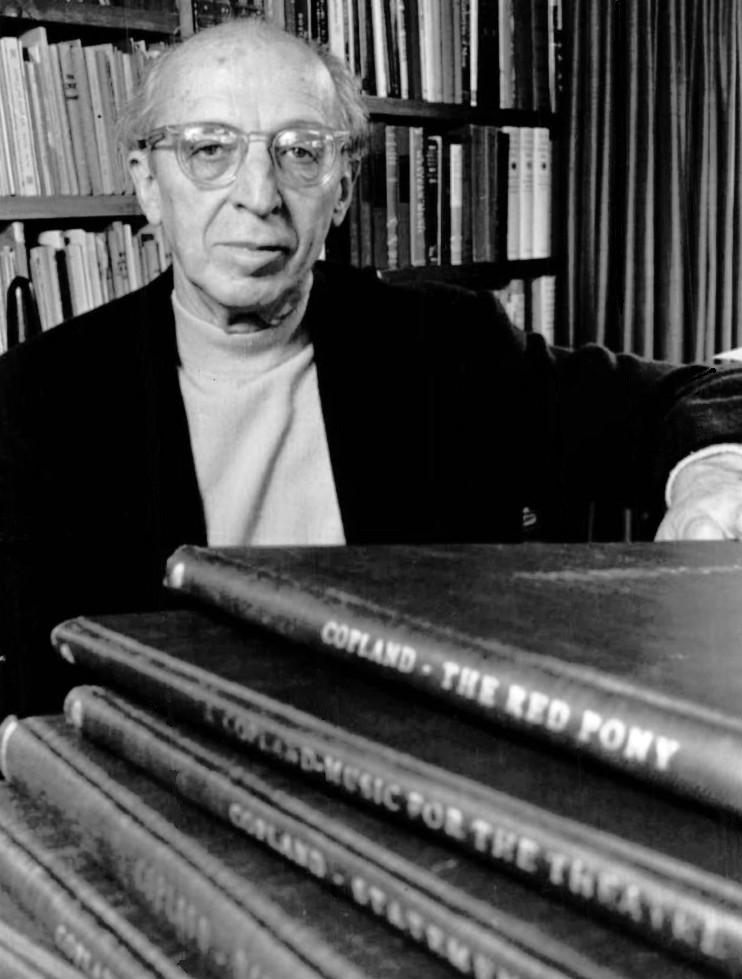
| Wikimedia |
Aaron Copland
1900 - 1990
- Born in Brooklyn, NY
- His older sister taught him piano; father wasn't musical, mother played piano
- Went to as many performances as he could
- At 15 years old, knew he wanted to be a composer
- At 21, moved to Paris to study composition; returned to America 4 years later
- Had a distinctive style and became known for modern composition techniques with American folk tunes, cowboy songs, church hymns, etc.
- Also taught composition students
- In the mid-1970s, started becoming quite forgetful. Diagnosed with Alzheimer's. By mid-1980s, lived at home with round-the-clock nursing care. Died of pneumonia shortly after his 90th birthday.
- Although he started late, Copland really liked conducting. "It's fun. It's well-paying. And you get applauded at the end. The orchestra does all the work and you turn around and take a bow. If you want to be nice, you ask the musicians to stand up, too, the poor dears."
Rodeo
1942
"In the 1940s, Agnes de Mille asked Copland to write a cowboy piece for her and the Ballet Russe de Monte Carlo. The result was the wildly successful ballet, Rodeo. The story takes place on a ranch and follows a cowgirl trying to impress the self-centered head wrangler. To attract his attention, she dresses like a cowboy and shows off her roping and riding skills. He still doesn't notice her. Finally, she catches his eye when she puts on a red dress and goes to the evening square dance, where she falls in love with a sweet and kind-hearted cowboy.
"The final scene is a lively square dance with the famous "Hoe-Down." This piece, one of the best known works by any American composer, has been featured in movies and ads. This movement captures the excitement of spirited country dance and fiddle music. Listen for the strings in the introduction - it sounds like the fiddlers tuning the instruments! Two main themes come from classic square dance tunes. The first is Bonyparte, played by the violins and violas. Next is Miss McLeod's Reel, played by the trumpets" (from the MSO's Teacher Resource Guide).
You might recognize "Hoe-Down" from the American Beef Council's commercials.
GERSHWIN - An American in Paris
| MasterworksBroadway.com |
George Gershwin
1898 - 1937
- Famous for writing Rhapsody in Blue (remember that clarinet excerpt?)
- While growing up in Brooklyn, NY, was very athletic and assumed music was something girls did. At 10, figured out music was awesome.
- Left school at 15 to work 10 hours/day in music stores, practicing, writing, and trying to get published
- Became rich and famous at 19 - had a 14-room apartment with a piano in the gym, owned every music book of the time, was a major art collector, drove a Mercedes Benz
- Big ego, but somehow it charmed people instead of repelling them - "Great, isn't it?"
- "When I am in my normal mood, music drips from my fingers."
- Died of a brain tumor
![]() |
| Photo is my own, taken in summer 2008 |
An American in Paris
1928
- Inspired by Gershwin's 1928 trip to Europe (he was originally from Brooklyn, NY)
- Wanted to become a better classical composer, so traveled to Paris
- Later that year, the NY Philharmonic commissioned a new work from Gershwin
- An American in Paris is a symphonic poem
- Copland said, "My purpose here is to portray the impression of an American visitor in Paris as he strolls about the city, listens to various street noises, and absorbs the French atmosphere."
- Some themes are repeated throughout the piece, depicting different moods
- “The opening gay section is followed by a rich blues with a strong rhythmic undercurrent. Our American… perhaps after strolling into a café and having a couple of drinks, has succumbed to a spasm of homesickness. The harmony here is both more intense and simpler than in the preceding pages. This blues rises to a climax, followed by a coda in which the spirit of the music returns to the vivacity and bubbling exuberance of the opening part with its impression of Paris. Apparently the homesick American, having left the café and reached the open air, has disowned his spell of the blues and once again is an alert spectator of Parisian life. At the conclusion, the street noises and French atmosphere are triumphant.” (Copland's program notes about the piece, found on the LA Philharmonic's website)
MOZART - Oboe Concerto in C major, Op. 314, movement I (Allegro aperto)
| Wikimedia |
Wolfgang Amadeus Mozart
1756 - 1791
- Born in Salzburg, Austria
- Father was a famous violinist
- 1 of 7 kids; only he and his sister made it to adulthood
- While sister was learning harpsichord, Mozart would play the pieces she was learning without practicing
- Father took the 2 on a concert tour through Europe 1762-1771
- Worked as a court musician and freelance composer. Very popular, but didn't make a lot of $. Never had a steady job.
- Got sick and died young, but wrote over 600 works
Oboe Concerto in C major, Op. 314
1777
- Written in 1777 for an Italian oboist
- Rewritten one step higher for flute in 1778 for a Dutch flutist
- The Dutch flutist had commissioned 4 flute quartets and 3 flute concertos. Instead of writing a new 3rd concerto, Mozart just rearranged the oboe concerto...as a result, the flutist didn't pay him for that piece.
- Fun fact: Mozart didn't like the flute and didn't trust flutists.
- Some detective work was required to figure out that this solo originated as an oboe piece.
- Cadenza at the end
Julia Simpson
Featured soloist
- Junior at Oconomowoc High School
- Won the 2014 MSO Stars of Tomorrow competition, so she got to perform the 1st movement of the Vaughan Williams Oboe Concerto with the MSO last spring
- Won the Waukesha Area Symphonic Band Concerto Competition
- Will be guest soloist in February with the Wisconsin Philharmonic, performing Mozart's Oboe Concerto
- Enjoys reading, studying, spending time with friends, and being a marching band drum major
TRADITIONAL - Yankee Doodle
- Originally started during the French and Indian War (1754-1763), when British and American soldiers fought side by side
- The well-dressed Brits made fun of their rag-tag American counterparts. Dr. Richard Schuckburgh, a British surgeon, wrote verses ridiculing them, and set the words to an old English folk tune.
- The Americans embraced the song as a proud colonist anthem.
- Definitions:
- Yankee: rash or lacking judgment
- Doodle: fool or simpleton
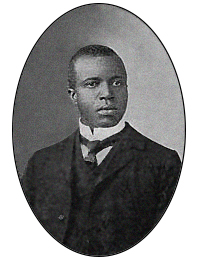
| Wikimedia |
Scott Joplin
1867 - 1917
- Believed to have been born in Texas between June 1867 and January 1868; moved to MO
- Played piano and cornet (like trumpet, but a conical bore instead of a straight bore)
- Gigged for over a decade before going to college, then focused on composing
- Considered to be one of the best ragtime composers
- Ragtime: popular style of music in late 1800s that started in St. Louis (MO) and New Orleans (LA). Known for syncopated or "ragged" rhythm in the melody, steady rhythm in the bass. Predecessor to jazz.
- People who didn't like ragtime music said it was an addictive poison that caused permanent brain damage and ruined people's morals.
- You might know two of his famous piano solos, "The Entertainer" and "Maple Leaf Rag."
Treemonisha
1910
- Opera (all text is sung) - finished in 1910. Joplin wrote the libretto (text) and music.
- Similar music to standard European operas (so, not a ragtime opera). Some ragtime style used to show "racial character." Like many French operas, includes a short ballet.
- Tried to get it professionally published, but ended up having to publish it himself in May 1911.
- Tried to have it performed numerous times, but a full production wasn't successfully staged until 1972 (>50 years after death)
- Story takes place in rural black Arkansas in September 1884
- Main character is Treemonisha, the only educated person in her community
- She leads her townspeople away from others who prey on ignorance and superstition. She gets kidnapped and almost thrown into a wasp nest. Her friend rescues her.
- The community then realizes the value of education.
- Joplin believed education was the key to equality for African Americans.
COPLAND - Lincoln Portrait
Copland's biographical information is listed towards the beginning of this post.
Lincoln Portrait
1942
- After the bombing of Pearl Harbor in 1941, conductor André Kostelanetz commissioned orchestral works that would present "a musical portrait gallery of great Americans." Copland said, "The choice of Lincoln as my subject seemed inevitable."
- Copland used quotes from Lincoln, along with themes from folk song "Springfield Mountain" and Stephen Foster's "Camptown Races."
- 3 sections of Lincoln Portrait
- Part 1: "I wanted to suggest something of the mysterious sense of fatality that surrounds Lincoln's personality. Also, near the end of that section, something of his gentleness and simplicity of spirit." Main theme ("Springfield Mountain") in the clarinet
- No break before Part 2. Brighter tone and tempo to depict the place and time in which Lincoln lived. Main theme is "Camptown Races"
- No break before Part 3, where Copland combines the melodies and moods of the first 2 sections with narration
- The narration contains quotes from and about Abraham Lincoln. The piece has had many famous narrators throughout its existence, including Neil Armstrong, Bill Clinton, Aaron Copland, Al Gore, Tom Hanks, Katharine Hepburn, Samuel L. Jackson, James Earl Jones, Barack Obama, and Margaret Thatcher.
- You can find the narration here.
Saturday, January 17, 2015
Treble Clef Literacy
The 4th and 5th graders started learning/reviewing their treble clef note names this week in preparation for our recorder unit. We started this process with a parody called "I Knew You Were Treble" by Jeanette Young.
We've also started practicing and creating our own acronyms to help remember the location of the letters. My personal favorite line acronym is "Evil Gummy Bears Destroy Florida."
We've also used a chant to go along with our hand signs (video to come later). "E G B D F - these are the lines of the treble clef. F A C E spells face in the space, uh-huh, face in the space, uh-huh, face in the space - yeah!"
Here are some online games for students to play to continue improving their note-reading skills:
Lines and spaces: this one from netrover.com, this one from musictheory.net, this one from Sound Feelings, musicracer.com (in the blue box, choose Note names; in the yellow box, choose Recorder), this one from Vic Firth, this one from classicsforkids.com, this one from teoria.com (to start, check Treble clef, lines and/or spaces (up to you - add ledger lines if you want a challenge), answer using note name, and uncheck the maximum time to answer; once you feel ready, start challenging yourself by changing the options!), notationtraining.com
Suggested apps:
Staff Wars ($0.99)
Note Squish ($0.99)
NoteBrainer (free)
Developing Musicianship Speed Reader ($0.99)
Music Tutor Free (free)
Staff Wars ($0.99)
Note Squish ($0.99)
NoteBrainer (free)
Developing Musicianship Speed Reader ($0.99)
Music Tutor Free (free)
Subscribe to:
Posts (Atom)